
Fernando Alonso and Le Mans: The Night He Conquered Endurance
There are races that crown champions, and there are races that immortalize them.
MOTOR RACING
Vitor Regis
5/29/20264 min read
There are races that crown champions, and there are races that immortalize them.
For Fernando Alonso, the 24 Hours of Le Mans was never merely another competition. It was a pilgrimage — a pursuit that began long before Formula One championships, before Monaco victories, before global fame. Hidden behind the relentless intensity of the Spaniard was a childhood fascination with one of motorsport’s most unforgiving rituals: Le Mans.
And in June 2018, under the dim skies of northern France, that fascination became history.
A Dream Beyond Formula One
By 2018, Fernando Alonso had already achieved what most drivers could only imagine. Two Formula One world championships, victories with Renault, legendary duels with Ferrari and McLaren, and a reputation as one of the most complete racers of his generation.
Yet Formula One no longer fulfilled him.
The modern grid had become restrictive, politically exhausting, and increasingly detached from the pure challenge Alonso sought. He was not looking merely for trophies. He wanted legacy.
That desire pointed toward motorsport’s mythical Triple Crown — victory at the Monaco Grand Prix, the Indianapolis 500, and the 24 Hours of Le Mans. Only one driver in history, Graham Hill, had completed the feat.
Alonso already possessed Monaco.
Le Mans was next.
His arrival to endurance racing shocked the paddock.
Toyota Gazoo Racing announced that Alonso would join its World Endurance Championship program for the 2018–19 “Super Season,” sharing the #8 Toyota TS050 Hybrid with Sébastien Buemi and Kazuki Nakajima. For Toyota, the move carried enormous symbolism. For Alonso, it represented something even greater.
It was the opening of a new chapter.
Toyota’s Curse
But Le Mans had its own ghosts.
Toyota arrived carrying scars few manufacturers could understand.
For nearly two decades the Japanese giant had pursued victory at Le Mans with almost tragic persistence. Speed was never the problem.
Fate was.
Mechanical failures, strategic heartbreaks, and cruel late-race collapses had become part of Toyota folklore. None hurt more than 2016, when victory disappeared with only minutes remaining after a devastating mechanical failure.
By 2018, Porsche had withdrawn from LMP1, leaving Toyota as overwhelming favorite.
Ironically, that made the pressure worse.
The paddock whispered the same phrase:
Toyota can only lose this race to itself.
Even preseason testing reinforced the narrative. The TS050 Hybrid appeared untouchable in pace and efficiency, faster than any private LMP1 rival.
Yet Le Mans respects no predictions.
It waits patiently for mistakes.
The Machine and the Man
The Toyota TS050 Hybrid was unlike anything Alonso had driven in Formula One.
Its cockpit was enclosed and claustrophobic. Visibility was limited. Traffic management demanded constant calculation. Unlike F1, where a driver battles a relatively small field, Le Mans forced Alonso to navigate dozens of slower GT and LMP2 cars while maintaining relentless pace.
And then there was the schedule.
No sprint. No ninety-minute duel.
Twenty-four uninterrupted hours.
Daylight.
Darkness.
Rain threats.
Exhaustion.
At Le Mans, a driver does not race the clock.
He negotiates with it.
Toyota prepared Alonso extensively through private tests and WEC rounds, where he learned the subtleties of endurance racing and adapted to the hybrid prototype’s complexity.
But nothing fully prepares a newcomer for the emotional gravity of Le Mans.
The Night of 2018
On 16 June 2018, the Circuit de la Sarthe came alive.
More than a race track, Le Mans resembles a temporary city devoted entirely to speed. Forest roads become sacred asphalt. Grandstands tremble beneath engines that scream through the night.
The #8 Toyota began from pole position.
Its sister car, the #7 Toyota, appeared equally capable of victory.
What followed was not a battle against rival manufacturers, but a tense internal duel.
Toyota versus Toyota.
Alonso’s first stints revealed something remarkable.
He was not merely adapting.
He was thriving.
His pace through traffic stunned observers. During the night — traditionally the most dangerous period of Le Mans — Alonso delivered some of the race’s defining performances. Calm, surgical and aggressive when necessary, he erased deficits and kept the #8 firmly in contention.
This was not a Formula One champion visiting endurance racing.
This was an endurance racer emerging in real time.
Through the darkness of La Sarthe, Alonso seemed almost transformed.
Hours passed.
Engines survived.
And for Toyota, survival itself felt unfamiliar.
The feared collapse never came.
By dawn, tension shifted from anxiety to cautious belief.
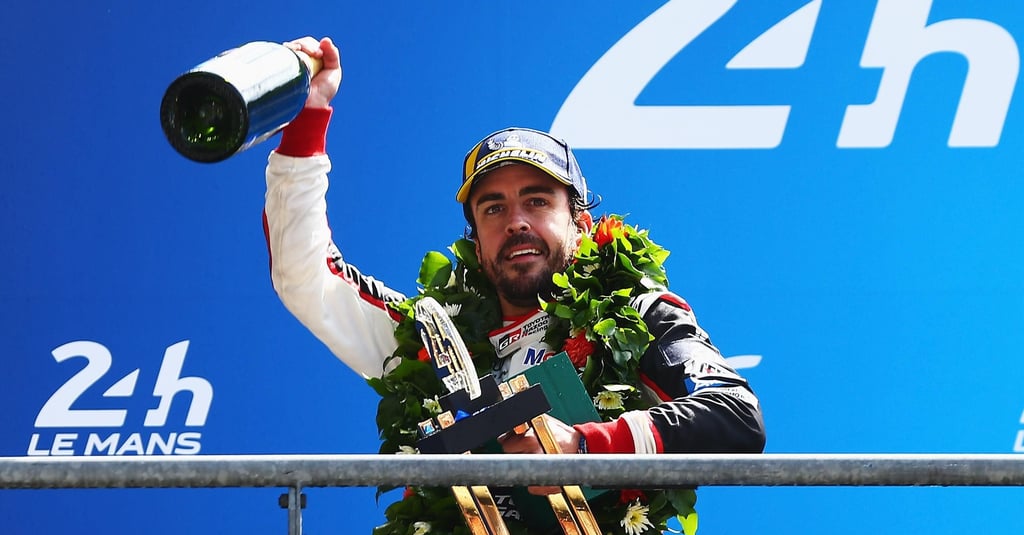
Kazuki Nakajima ultimately guided the #8 Toyota home after 388 laps, securing victory ahead of the sister #7 car and delivering Toyota its long-awaited first Le Mans triumph. For Alonso, Buemi and Nakajima, it was a historic first victory at the event.
At last, the curse was broken.
A Different Kind of Victory
When Alonso climbed from the car, celebration mixed with relief.
Le Mans victory feels different.
Formula One victories often explode with immediacy — champagne, emotion, noise.
Le Mans settles more slowly.
It arrives through fatigue.
The body aches.
The mind struggles to process what has happened.
Because finishing Le Mans is an achievement.
Winning it is something else entirely.
For Alonso, the triumph carried layered meaning.
He had conquered one of motorsport’s sacred events on his first attempt.
He had helped Toyota escape decades of heartbreak.
And he had moved one step closer to the Triple Crown.
But perhaps most importantly, he had reminded the racing world of something many had forgotten.
Fernando Alonso was still evolving.
The Sequel: 2019
Great stories often demand repetition.
One year later, Alonso returned.
The 2019 edition brought fresh drama.
Again, Toyota controlled the race, but internal tension simmered between the #7 and #8 cars. Late mechanical concerns and tire-sensor problems struck the leading #7 machine, allowing the #8 crew of Alonso, Buemi and Nakajima to inherit the lead during the final hours.
Nakajima crossed the line first once more.
Back-to-back victories.
Two Le Mans wins in two attempts.
The triumph also sealed Alonso’s FIA World Endurance Championship title.
An extraordinary statistic emerged:
Formula One champion.
Daytona winner.
Two-time Le Mans champion.
Still pursuing history.
Legacy at La Sarthe
Fernando Alonso has not yet completed the Triple Crown.
Indianapolis remains unfinished business.
But Le Mans altered his legacy permanently.
For decades, critics debated whether Alonso’s career had been hindered by difficult choices and unfortunate timing in Formula One.
Le Mans changed the conversation.
Because endurance racing stripped away machinery politics and championship narratives and returned motorsport to its most primal question:
Can you master the machine, the night, and yourself?
At Le Mans, Alonso answered.
Not once.
Twice.
And beneath the French dawn, surrounded by exhausted engineers and victorious Toyotas, the boy who had once watched Le Mans from Spain finally stood where he had imagined all along:
At the center of motorsport history.
Sources
Toyota Gazoo Racing – Fernando Alonso Goes to Le Mans
https://toyotagazooracing.com/wec/special_/2018-2019/fernando-alonso-goes-to-lemans/
24 Hours of Le Mans – Fernando Alonso Driver Record
https://www.24h-lemans.com/en/track-record/driver/fernando-alonso-9012
2018 24 Hours of Le Mans – Historical Results
https://en.wikipedia.org/wiki/2018_24_Hours_of_Le_Mans
2019 24 Hours of Le Mans – Historical Results
https://en.wikipedia.org/wiki/2019_24_Hours_of_Le_Mans
Subscribe to our newsletter
Enjoy exclusive special deals available only to our subscribers.








Copyright © Vitor regis
são paulo, brazil
cnpj:66.825.015/0001-05