
Mercedes-Benz SLR McLaren
There are automobiles that become successful products, and there are those that transcend engineering to become cultural artifacts.
CARS
Vitor Regis
5/27/20265 min read
The Silver Arrow Reborn
There are automobiles that become successful products, and there are those that transcend engineering to become cultural artifacts. The Mercedes-Benz SLR McLaren belongs firmly to the latter category. Part supercar, part grand tourer, and part Formula 1 experiment for the road, the SLR emerged during a unique era when German precision and British racing obsession briefly merged to create one of the most fascinating machines of the twenty-first century.
Produced between 2003 and 2010, the SLR McLaren was more than a collaboration between two automotive giants—it was a statement of ambition. Even today, decades after its debut, the SLR remains impossible to ignore: dramatic proportions, a supercharged soundtrack, and a philosophy unlike anything else produced before or since.
Origins: The Return of the Silver Arrow
The initials SLR stand for Sport Leicht Rennsport—“Sport Light Racing.” The designation carried enormous historical weight inside Mercedes-Benz, tracing its lineage back to the legendary 1955 300 SLR, one of motorsport’s most iconic racing cars. That machine, piloted by greats such as Stirling Moss, helped define the myth of Mercedes’ “Silver Arrows.”
By the late 1990s, Mercedes sought to revive that legacy for a modern audience.
The timing was ideal. Mercedes-Benz and McLaren were deeply intertwined through Formula 1. Mercedes supplied engines to the McLaren racing team, and their partnership dominated headlines on the world stage. In 1999, Mercedes introduced the Vision SLR Concept, a futuristic coupe inspired equally by the 1950s racer and contemporary Formula 1 design language. The public reaction was immediate and overwhelmingly positive.
What began as a concept soon evolved into an ambitious production project.
Yet the SLR would not be a conventional Mercedes.
Mercedes handled styling and luxury philosophy, while McLaren assumed responsibility for engineering, testing, and assembly in England. The resulting automobile became one of the rare supercars jointly developed by two manufacturers with entirely different identities and priorities.
Design: A Machine of Unusual Beauty
At first glance, the SLR appears almost surreal.
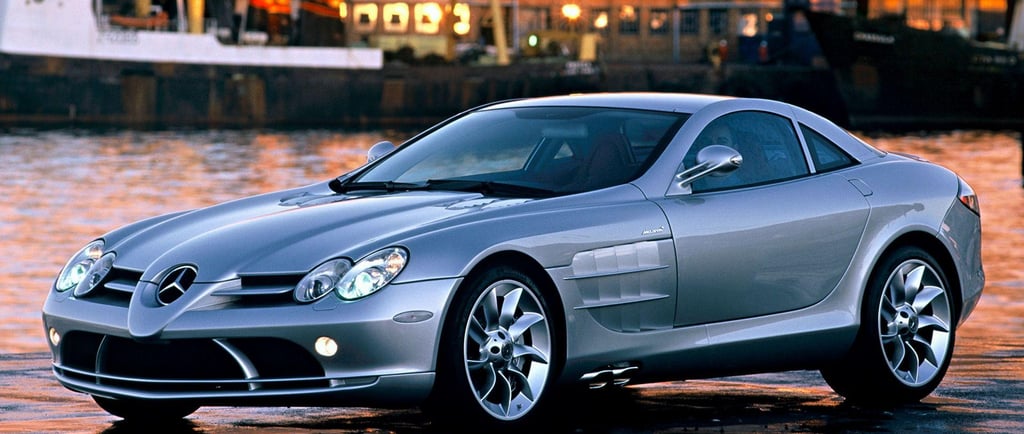
Its proportions break traditional supercar logic. Rather than adopting a compact mid-engine silhouette like the Ferrari Enzo or Porsche Carrera GT, the SLR features an extraordinarily long hood, a cab-rearward stance, and muscular rear proportions.
The design was intentional.
McLaren engineers moved the engine deep behind the front axle to improve balance, creating a front-mid-engine layout. This engineering decision extended the hood dramatically, producing a silhouette reminiscent of vintage endurance racers.
The body itself was equally extraordinary.
Built largely from carbon fiber, the SLR employed advanced lightweight construction techniques uncommon in production cars of its era. Mercedes even developed what was described as the world’s first carbon-fiber frontal crash structure in a road vehicle, blending racing innovation with road-car safety.
Distinctive side gills cooled the massive engine bay, while the famous butterfly doors elevated the theatrical experience. Nothing about the SLR was subtle.
And that was precisely the point.
The Heart of the Beast
Beneath the immense hood rested one of AMG’s finest creations.
The M155 engine—a hand-built 5.4-liter V8 equipped with a mechanical supercharger—produced 626 horsepower and 780 Nm of torque in standard form. Each engine was assembled by a single technician according to AMG’s “One Man, One Engine” philosophy.
Unlike many modern supercars that rely on turbocharged efficiency and hybrid complexity, the SLR’s power delivery felt raw and immediate.
The supercharger emitted a distinctive mechanical shriek, layered beneath the thunder of eight cylinders. Torque arrived almost instantly, pushing the car forward with remarkable violence.
Performance figures were staggering for the early 2000s:
0–100 km/h in approximately 3.8 seconds
Top speed between 334 and 338 km/h
Rear-wheel drive
Carbon-ceramic brakes
Active aerodynamic systems including an air-brake rear spoiler
Yet perhaps the SLR’s most controversial feature was its transmission.
Mercedes chose a reinforced five-speed automatic rather than a manual or dual-clutch gearbox. Critics initially viewed the decision as conservative, especially when rivals embraced more aggressive setups. Mercedes argued durability and torque capacity made the automatic the superior solution. In hindsight, this choice became central to the SLR’s personality.
It was not trying to be a stripped-out racing prototype.
It wanted to be something rarer—a supercar capable of crossing continents in comfort.
Mercedes Versus McLaren
The SLR’s unusual character reflected the tensions behind its creation.
Mercedes envisioned an ultra-luxurious grand tourer, filled with comfort, technology, and prestige. McLaren, shaped by motorsport DNA, preferred a sharper, lighter, more focused machine.
These opposing philosophies reportedly created friction throughout development. McLaren pushed for increased performance and purity; Mercedes insisted the car must remain unmistakably a Mercedes-Benz.
The final product became a compromise.
And perhaps that compromise explains why the SLR feels so unique.
It is simultaneously brutal and refined.
A driver could attack a highway at over 300 km/h and still enjoy climate control, leather upholstery, and luxury appointments worthy of a flagship Mercedes.
Few supercars before—or since—have occupied that middle ground.
The Variants: Evolution of a Legend
As production continued, Mercedes and McLaren expanded the SLR family.
SLR 722 Edition
Introduced in 2006, the 722 Edition paid tribute to Stirling Moss and navigator Denis Jenkinson, winners of the 1955 Mille Miglia. Their victorious Mercedes carried the racing number 722, representing a 7:22 a.m. start time.
The 722 Edition sharpened the SLR formula:
Power increased to 650 horsepower
Revised suspension
Larger brakes
Enhanced aerodynamics
Lower ride height
More aggressive styling
The result was faster, louder, and more focused—arguably the definitive coupe version.
SLR Roadster
In 2007, Mercedes unveiled the Roadster.
Removing the roof might have compromised rigidity in lesser vehicles, but engineers preserved much of the coupe’s performance through extensive reinforcement and a sophisticated triple-layer soft top. Remarkably, the Roadster remained among the fastest open-top cars in the world.
SLR Stirling Moss
The final evolution arrived in 2009.
The Stirling Moss edition abandoned windshield and roof entirely, embracing a radical speedster design inspired by 1950s racing machines. Limited to only 75 units and available exclusively to existing SLR owners, it represented the ultimate expression of the platform—part sculpture, part race car, and entirely unforgettable.
Legacy and Reappraisal
When the SLR debuted, reactions were divided.
Some journalists admired its engineering and drama; others criticized its weight and grand-touring focus compared with more hardcore rivals like the Carrera GT and Enzo.
Time, however, has a way of reshaping reputation.
Modern collectors increasingly view the SLR as one of the most significant supercars of its generation. Roughly 2,100 examples were produced, ensuring rarity while preserving exclusivity.
More importantly, the SLR now represents something that can no longer be replicated.
It emerged from a brief historical intersection:
Mercedes and McLaren united in Formula 1
Analog performance meeting digital sophistication
Supercharged power before hybrid dominance
Luxury and racing engineering sharing equal influence
The SLR had no true successor.
The Mercedes-Benz SLS AMG that followed carried different ambitions and a wholly Mercedes identity. McLaren, meanwhile, eventually pursued its own independent supercar lineage. The collaboration ended, and with it vanished the possibility of another machine quite like the SLR.
Conclusion
The Mercedes SLR McLaren is not merely remembered because it was fast.
Many cars are fast.
The SLR endures because it embodied contradiction: elegant yet intimidating, luxurious yet ferocious, German yet British, historical yet futuristic.
It was a machine born from partnership, disagreement, and ambition.
And perhaps that is why it remains so captivating.
The SLR McLaren was never intended to fit neatly into the automotive world. Instead, it created a category of its own—a Silver Arrow reborn for the modern age, carrying the spirit of motorsport into a new century with unmistakable presence and unforgettable sound.
Sources:
Mercedes-Benz Public Archive
Mercedes-Benz / McLaren historical overview
Mercedes-Benz Media Archive
Technical and model history references
Subscribe to our newsletter
Enjoy exclusive special deals available only to our subscribers.








Copyright © Vitor regis
são paulo, brazil
cnpj:66.825.015/0001-05