
Rolex — The Time of Eternity
Time has never been merely a sequence of numbers moving across a dial. For kings, explorers, pilots, and athletes, it has represented precision, survival, and prestige.
WATCHES
Vitor Regis
5/30/20265 min read
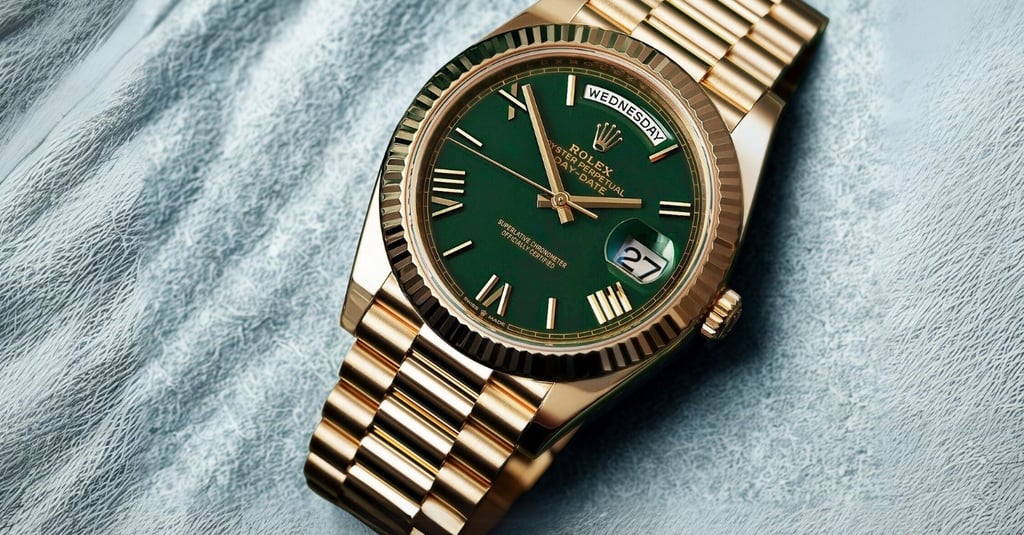
Time has never been merely a sequence of numbers moving across a dial. For kings, explorers, pilots, and athletes, it has represented precision, survival, and prestige. Few companies understood this truth as profoundly as Rolex. More than a manufacturer of watches, the Swiss maison built a cultural symbol that exists at the intersection of luxury, engineering, and identity.
The story of Rolex begins far from the Swiss Alps.
In 1905, in London, a young German entrepreneur named Hans Wilsdorf founded a company dedicated to distributing timepieces. At the dawn of the twentieth century, pocket watches still dominated society, while wristwatches were often viewed with skepticism—delicate accessories considered unreliable and unsuitable for serious use.
Wilsdorf saw the future differently.
He believed the wristwatch could become not merely fashionable, but extraordinarily precise and dependable. It was a radical idea for its era. Together with Alfred Davis, he created Wilsdorf & Davis, importing high-quality Swiss movements and fitting them into refined cases for the British market.
The name “Rolex” emerged in 1908.
Its exact origin remains wrapped in a degree of mystery, but Hans Wilsdorf explained that he wanted a word that was short, memorable, easy to pronounce across languages, and elegant enough to fit on a watch dial. The result became one of the most recognizable names on Earth.
Soon after, the company relocated to Geneva, Switzerland, positioning itself at the center of the world’s watchmaking tradition.
From the beginning, Wilsdorf’s obsession was precision.
In 1910, a Rolex wristwatch received an official Swiss certificate of chronometric precision—an extraordinary achievement for a wristwatch of that period. Four years later, Rolex earned the prestigious Class A certificate from the Kew Observatory in England, an honor generally reserved for marine chronometers.
The message was unmistakable:
The wristwatch was not a decorative toy.
It was an instrument.
Yet Rolex sought more than accuracy.
It sought resilience.
In 1926, one of the defining breakthroughs in horological history arrived with the Rolex Oyster. The model introduced a hermetically sealed case designed to protect the movement from water, dust, and moisture—a revolutionary concept at a time when most watches remained highly vulnerable to the environment.
Hans Wilsdorf understood that innovation required proof.
In 1927, British swimmer Mercedes Gleitze attempted to cross the English Channel while wearing a Rolex Oyster around her neck. After more than ten hours in freezing waters, the watch emerged functioning perfectly.
Wilsdorf transformed the feat into an international campaign.
Newspapers celebrated the achievement. Storefront displays showcased Oyster watches submerged in water-filled aquariums. What the public witnessed was not merely advertising, but the deliberate creation of a narrative.
Rolex learned early that engineering and storytelling could reinforce one another.
The company continued to redefine the standards of watchmaking.
In 1931, Rolex introduced the Perpetual rotor—a self-winding mechanism powered by the natural movement of the wearer’s wrist. While automatic systems had existed in experimental forms before, Rolex refined the concept and helped establish it as a cornerstone of modern mechanical watchmaking.
The Oyster and the Perpetual became the foundation of Rolex identity:
Resistance.
Precision.
Autonomy.
Throughout the twentieth century, Rolex developed a strategy unlike any of its competitors—associating its watches with the outer limits of human achievement.
The brand accompanied expeditions, deep-sea dives, motorsport events, and scientific missions.
In 1953, when Edmund Hillary and Tenzing Norgay reached the summit of Mount Everest, Rolex watches were connected to the expedition’s story. That same year, Rolex introduced the Explorer, inspired by the spirit of endurance and discovery embodied by the ascent.
This was more than product development.
It was mythology.
Rolex was no longer selling only steel and gears.
It was selling adventure.
The 1950s became a golden age for the maison, producing timepieces that would shape horological culture forever.
The Submariner, introduced in 1953, was designed for professional divers and quickly became the definitive dive watch. With its rotating bezel, remarkable durability, and unmistakable profile, it transcended its technical purpose and entered popular culture.
Two years later came the GMT-Master, developed in partnership with Pan American Airways. Created for pilots navigating the rapidly expanding era of international aviation, the watch allowed simultaneous reading of multiple time zones.
Then, in 1956, Rolex unveiled the Day-Date—the first wristwatch to display both the date and the day of the week written in full. Over time it earned the nickname “the President’s watch,” worn by political leaders and influential figures around the world.
Each model served a purpose.
Nothing felt arbitrary.
This balance between utility and refinement became the defining language of Rolex design.
Another essential dimension of Rolex lies in its independence.
After Hans Wilsdorf’s death in 1960, the company remained under the control of the Hans Wilsdorf Foundation, a philanthropic organization created to secure Rolex’s continuity and long-term vision. Unlike many luxury brands pressured by quarterly earnings or shareholder expectations, Rolex retained unusual strategic freedom.
That independence shaped its philosophy.
Rolex rarely pursues fleeting trends. Its designs evolve gradually—sometimes almost imperceptibly—creating a visual continuity few luxury brands can match. A contemporary Submariner still carries the genetic identity of its ancestors from decades ago.
This continuity exerts a powerful psychological effect.
For many owners, a Rolex is not perceived as seasonal fashion or disposable luxury, but as an object meant to endure, to be repaired, preserved, and eventually inherited.
In the modern era, Rolex has become not only a cultural symbol but an economic phenomenon.
Few luxury brands have experienced comparable demand and value retention in the secondary market. Certain stainless-steel sports models—particularly the Daytona, GMT-Master, and Submariner—often command waiting lists and prices that exceed retail value.
Part of this phenomenon stems from carefully controlled production.
Another part comes from over a century of accumulated prestige.
Perhaps no watch embodies this intersection of performance, celebrity, and myth more than the Daytona.
Closely associated with actor and racing enthusiast Paul Newman, the Daytona evolved into one of the most coveted collector’s watches in existence. In 2017, Paul Newman’s own Daytona was auctioned for a record-breaking sum, becoming one of the most valuable wristwatches ever sold.
Yet Rolex’s influence extends far beyond auctions.
It exists in cinema, sport, and collective imagination.
Early portrayals of James Bond featured Rolex watches. International tennis tournaments, yachting competitions, and motorsport events have carried the brand’s signature. Across cultures and languages, the name Rolex has become almost synonymous with success and excellence.
Still, prestige invites criticism.
Some watch enthusiasts argue that Rolex’s public image has become too closely tied to wealth and status, overshadowing the deeper artistic dimensions celebrated by certain haute horlogerie houses. Others criticize the exclusivity and speculative behavior surrounding highly sought-after references.
And yet, even critics rarely dismiss Rolex entirely.
Because behind the marketing lies genuine engineering.
Rolex movements are respected for their reliability, strict tolerances, and rigorous testing standards. The company invests heavily in proprietary alloys, advanced metallurgy, and vertically integrated manufacturing systems that allow extraordinary control over quality.
In an industry often divided between artisanal tradition and industrial production, Rolex occupies a rare middle ground.
It is not merely an old-world watchmaker.
Nor merely a modern manufacturer.
It is something in between.
Perhaps that is the secret of its enduring fascination.
More than a century after its founding, Rolex continues to represent a quiet promise—the belief that precision, permanence, and excellence can outlast time itself.
And there is a certain irony in that.
The company that built its legacy by measuring seconds ultimately created something far greater than them.
Because a Rolex was never simply about telling time.
From the very beginning, it was about humanity’s enduring desire to make time eternal.
Subscribe to our newsletter
Enjoy exclusive special deals available only to our subscribers.




Copyright © Vitor regis
são paulo, brazil
cnpj:66.825.015/0001-05